Season Eight: Week 27

IMG_5610.jpg

Be not afraid of greatness…

Tuesday / March 12 / 2019
Written by Emma

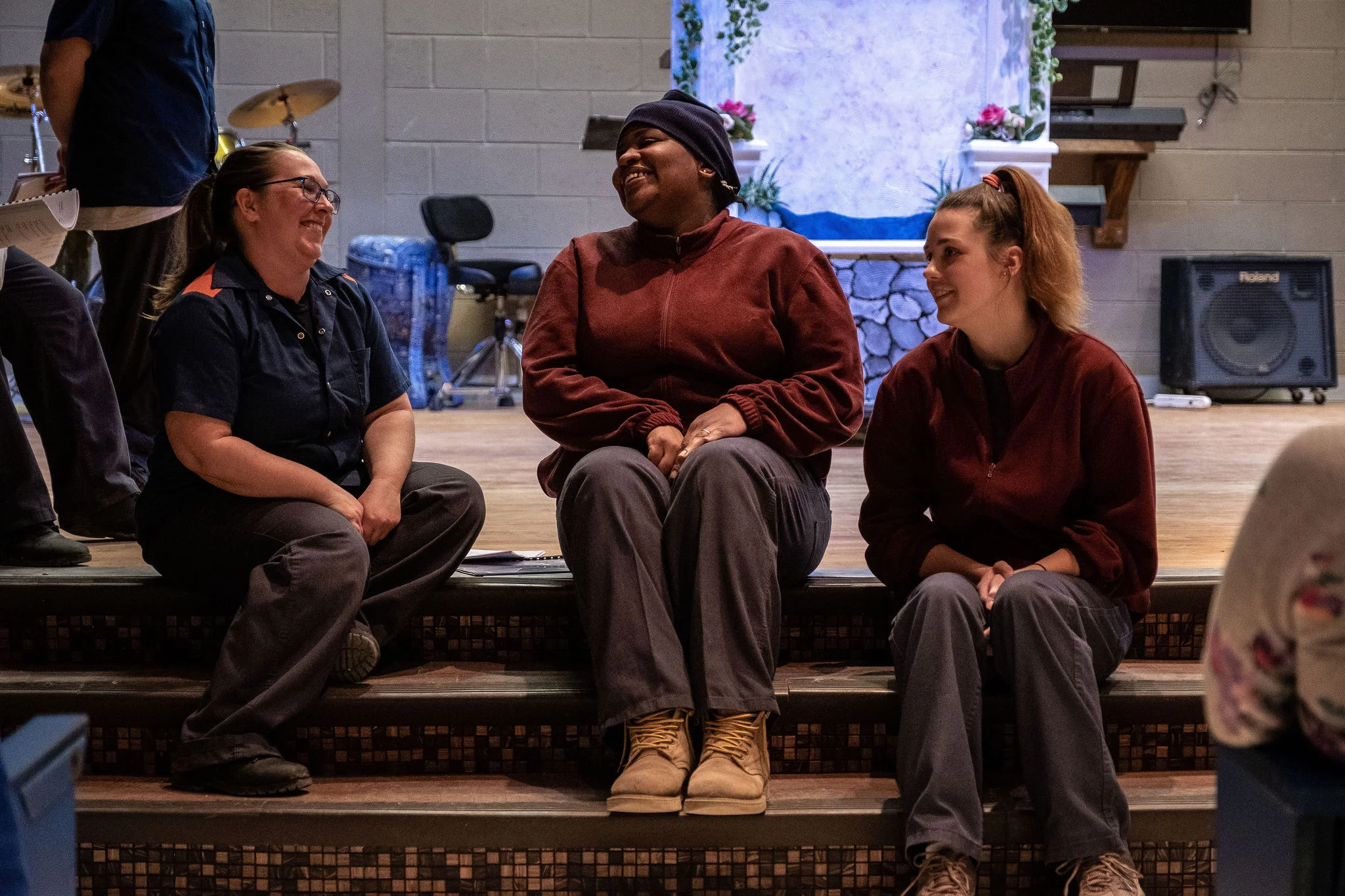
One of this season’s dedicated new members took a seat next to me as the ensemble trickled in. Enthusiastically, she shared with me that she had been noticing Shakespeare everywhere this week—in movies, in books, and even in casual conversation. This was curious, as I too had been seeing reference after reference crop up “in the wild” in recent days. Together we began to ponder the deep cultural impacts of Shakespeare, such that we both in our vastly different day-to-day lives feel the influences of his work regularly. With a smile on her face, this once-shy ensemble member stated that she fully intends to keep building her Shakespeare knowledge once she gets out. Snaps to that!

As check-ins began, it became clear that we were not the only two tuning in to this channel. One woman shared that she too had had a Shakespeare run-in. She is currently enrolled in a creative writing course through Eastern Michigan University. The course syllabus includes a lesson in iambic pentameter, which is to Shakespeare what butter is to Paula Deen. As her instructor explained to the class the rhythmic ins-and-outs of iambic pentameter, she had grown excited. “Like, that’s kind of musical!” she said to us. “And Shakespeare was a really smart dude. And if he was alive today, he would be so cool to sit down with.” She beamed into the circle as us facilitators scrambled to record the quote gold. “He was kind of brilliant! Yeah, I think I fell in love with Shakespeare.”

After raising the ring, we dove back in to the scene work that we have been plugging away at for the past few sessions. This type of work is where the play begins to find its feet and take off. However, it is also a quite tedious and practical process. We picked up where we left off with Act 3 Scene IV—an absolute doozy of a scene that has many moving parts and kinks to work out. The slow-moving process meant that some folks were on stage for long stretches hammering out blocking, while others remained in the audience patiently watching.

Within the first few moments of rehearsing it was clear that the energy was a bit distracted. Both the actors on stage and the ensemble members in the audience seemed detached from the play. A good deal of this could be attributed to situational elements, but even more was simply due to the fact that tapping in to comedic energy is not an easy task. One does not need to dive so deep to access feelings of anger and sadness as to access levity and mirth. It takes a lot of effort to get there outside of prison; inside, it is an absolute feat. Yet the ensemble prevailed. We kept moving, incorporating, blocking, growing.

This exhausting process left one of our senior ensemble members agitated. As we moved through the last minutes of rehearsal, she calmly expressed her irritation. Frannie paused work for a moment to validate that irritation and acknowledge that, indeed, this stage is frustrating. It is repetitive, it is nitty gritty, and it is absolutely necessary. As with all good things, this play will not come easy. With all feelings heard, we picked right back up.

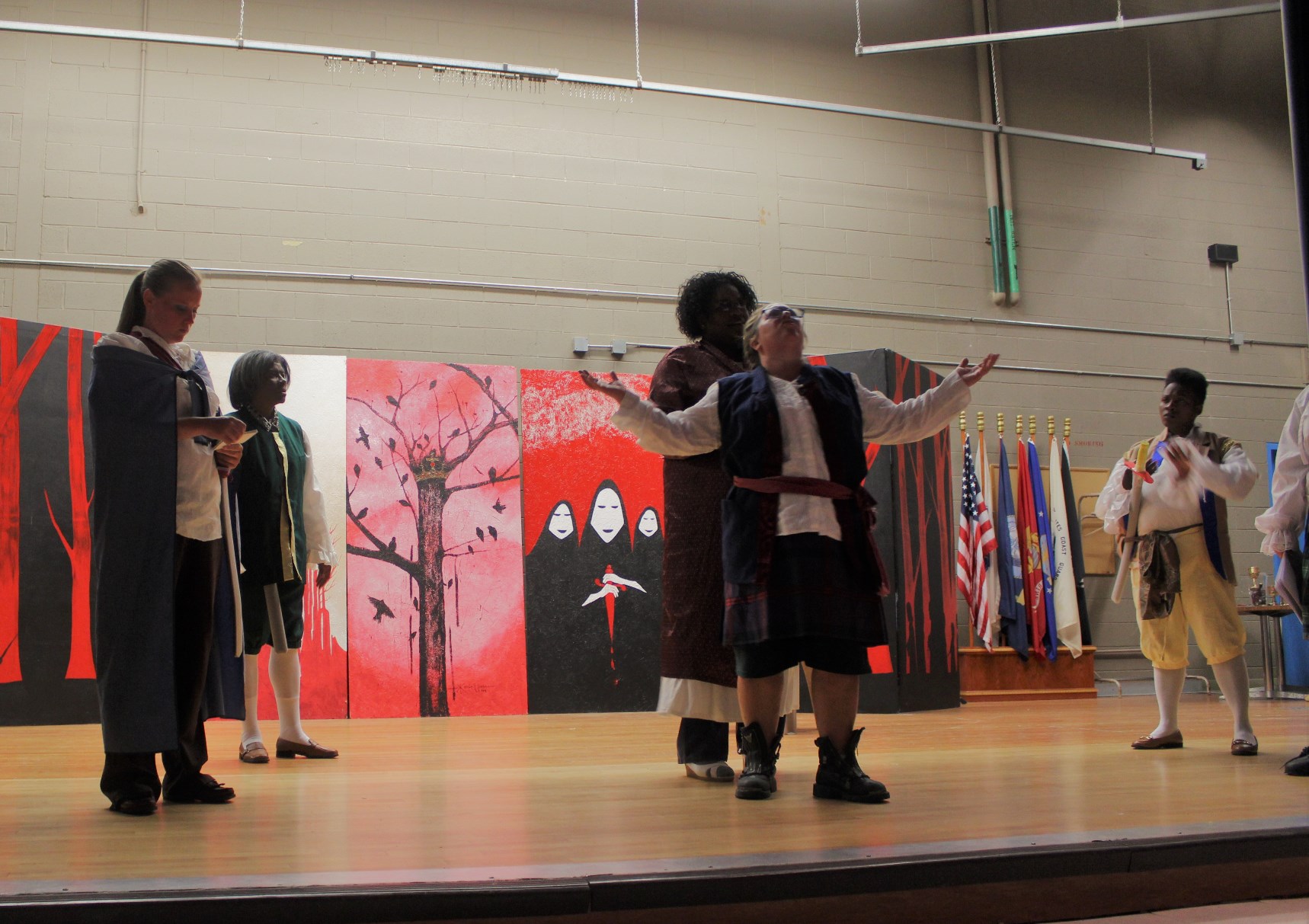
Outside of scene work, other “big picture” things were happening. One of our overarching goals for the day was to get all remaining costume ideas nailed down. Costumes can be a powerful vehicle for projecting individual character personality traits, and as such, we aim to give ensemble members as much creative freedom as possible when deciding what their character is going to be wearing. We fielded the query to those who had not yet selected ideas, including our Orsino. Without hesitation, she said “Tights!” This was clearly not her first time envisioning Orsino’s getup. She went on to outline her desired look of a puffy shirt, elf shoes, and floppy hat with feather (described by Frannie as “Renaissance Man”). The whole ensemble laughed at the mental image of a (literally) puffed up Orsino strutting his stuff.

Picking a costume concept can be easier said than done—especially for folks who aren’t accustomed to flexing that creative muscle. One of our first-season members, who is playing Antonio, wasn’t sure what direction she’d like to take her character. “Whatever you think, Frannie,” she said when asked. “Whatever you think is good!” A little while later, she and I sat together away from the scene work to dive into costume details without any of the group pressure. She expressed to me that she wasn’t sure about her costume because she was still figuring out her character—his motives, his experience, etc.—and simply didn’t feel connected to him yet. In a play as convoluted as Twelfth Night, this is entirely understandable. Even more so considering Antonio’s entire romantic drive never gets adequately addressed and is mostly left up to interpretation. We decided that to land on a costume, we should start at the very beginning. As Rodgers and Hammerstein told us, that is a very good place to start.

She and I brushed up on the basic outline of the play, then honed in on Antonio’s role within that outline. We focused on what the play was about from his perspective—what he sees and what he cares about. After a few minutes of this, she was already visibly warming up to Antonio. When we came back to costumes she had some firmer ideas. “Pinks and purples,” she stated, “and a beret!” By the end of the night, she had outlined an entire costume concept, from flowy shirt to patent-leather shoes—a complete 180 from “whatever you think is good,” and an undeniable win in my mind.

We raised the ring, sending with it the frustration, fatigue, and ultimately triumph of the day.

Friday / March 15 / 2019
Written by Matt

One of our new members had an experience familiar to most people who have done theatre: “So, this may be crazy, but I started dreaming about Shakespeare,” she confessed. Everyone was curious--what were these dreams about? What were they like? Were they sad or happy? Was Shakespeare himself in them, or any of the characters? Or were they about SIP meetings?

Turns out they were anxiety dreams about forgetting lines, missing an entrance, or (this has always been my favorite) walking on and realizing that there’s a completely different play happening. The facilitators and a few of the women who have been on stage before nodded along--this woman joined a tradition as old as the theatre: getting nervous about the theatre!

After check-in, we decided to finish the nitpicky table work we started last week. This isn’t everybody’s cup of tea, but some ensemble members actually seemed excited to get back to it, especially since energy was fairly low. Frannie took those people to the back of the house to work out cuts.

But what to do with the zannis and people who didn’t want to sit around to talk about cuts? We did the opposite: movement work. Lauren stepped up (with no warning, it should be said!) to lead a group of us on stage in stretches and warm-ups before diving into a high-energy “fashion show,” in which each person strutted their way down a “runway” and showed off their character’s “outfit” while the rest of us oohed and aahed and pretended to take pictures. It was goofy and fun and really good as a way to loosen up and lose some of the self-consciousness that dogs all of us to some extent.

I participated, so my notes aren’t great. Actually, no one’s notes are very good; we were all jumping around or making cuts! But it was a good time, especially when some of the women doing cuts came up to join us on stage.

I’ll close this short entry with one more bit of costume brilliance. Our Curio had been absent during our last costume conversation, so I talked to her quickly about it. What came out was pure gold: “I don’t know,” she said. “I don’t really have a vision--” (which is usually the thing people say before describing an amazing vision). “He’s got knee-high boots, greet pants, white shirt. … He’s like Robin Hood! Awwww… he just wants to hunt! And this dude [Orsino] is just a sad sack, and I just want to be, like, ‘Dude, we could go hunting and get us some women and have a good time!’”

No vision, indeed.

Season Eight: Week 26

shakespeare_behind_bars-21.jpg

“Shakespeare is for everyone.”

Tuesday / March 5 / 2019
Written by Matt

Tonight started off with some good news: two of the women had “made a third Shakespeare session!” They were running lines at work. “We have admirers,” one of them said, and shared that a co-worker got so into their performances that she asked them to pause while she left the room, so she wouldn’t miss anything!

Then some mixed news: our Feste admitted that she was feeling overwhelmed and didn’t think she’d be able to continue in that role. This is too bad, but, to be honest, it was as much a relief as a disappointment. We appreciated her honesty, and there’s still time for someone to step into that role without causing panic! A couple of our ensemble members said that they had been talking about it, and they wanted to pick a new Feste as soon as possible. Everyone agreed, and almost instantly a new member raised her hand and said that she still didn’t really have a role, but that she had a lot of trepidation about stepping into such a large part.

“I feel like, if you were willing to take on Orsino,” said one woman, referring to the Orsino-off we had a while back, “you could do Feste.” The previous Feste talked her up, too: “You’d be awesome!” Our putative Feste still looked a little bit scared, but Coffey (who has played Feste) said that she’d sit down with her and talk through the part. Frannie assured her that we could totally cut Feste’s part in half or more, and that was that.

...Or almost that. An ensemble member who for years has struggled with stage fright offered--partly as a way to assure our new Feste--to take on the now-open role of Valentine if the other woman, in fact, took over as Feste.

After lowering the ring, we set to work. Our new Feste went to the back of the auditorium with Coffey to talk. Meanwhile, the rest of us talked through Act III, scene iv, the long and varied scene that we stumbled through hilariously last week. More than anything, it turned out, we needed to cut that scene down to size!

As usual, the cutting process was both tedious and liberating. It is, on the one hand, a piece of drudgery that can be frustrating and painstaking. It’s intellectually challenging, requiring knowledge of the text and the characters, but there isn’t much payoff for most people. A few people (and we’ve had some of them!) really enjoy the act of cutting down the play while maintaining the text’s integrity, but most are just happy when it’s over.

On the other hand, however, it is the ultimate act of “ownership” over the text, and successful cutting of the script demonstrates not only knowledge of the play, but understanding of the workings of Shakespeare’s language. The 90-minute version of the play that we produce each year is truly “ours,” reflecting the priorities and character of that year’s ensemble uniquely--another group would produce a different cut, which would be theirs. If it is one of the central tenets of Shakespeare in Prison that no one “owns” Shakespeare because everyone owns Shakespeare, then there is no clearer demonstration of that principle than cutting the play to shreds--our shreds, shreds that still tell Shakespeare’s story, but in our way.

After cutting the scene down to size, we put the new, shorter version on its feet. It was delightful, as usual, and notes are a little sketchy, but here are some highlights:

  • Malvolio experimented with all sorts of funny entrances to show off the yellow stockings and cross garters.

  • The cross-garters, we determined, are actually fishnet stockings.

  • Because! ….Malvolio is, in fact, the leg-lamp from A Christmas Story.

  • And Malvolio may dance on to the theme of Pepe le Pew. And may actually be Bugs Bunny in drag. It’s not clear.

  • Malvolio can’t (or won’t) get Maria’s name right, which drives Maria CRAZY.

  • Maria compulsively dusts off Olivia’s face.

  • Olivia is, in fact, not “like” Cher from Clueless—she is Cher from Clueless.

  • Sir Andrew rides a stick-horse.

I’ll close with a line from Coffey’s notes. She sat in the back with our new Feste (who is now totally psyched to take on the role!) for most of the session. Her notes end: “I’m sitting back here by myself while [Feste] goes to the bathroom. There is so much joy on everyone’s face.”

Friday / March 8 / 2019
Written by Matt

Our Orsino got the Shakespeare Purple Heart / Art is Suffering prize today. Her bunkie was having her demonstrate Orsino’s over-the-top personality, and, in performing, she overdid it with her hamstring. When she revealed that she wasn’t acting out lines from Shakespeare but rather riffing on them, a veteran member gravely warned, “Oh. So you was making fun of him. And he didn’t like that.” Unfortunately for our Orsino, the ensemble was dead-set on doing her first scene!

Orsino gamely hobbled to the “stage” (we were in a classroom today), followed by the zannis and Curio. I challenged her to make her Orsino as big as usual… without further paining her hamstring! In the small space, the group ran through the scene--it’s the “If music be the food of love” scene, which we’ve done a million times with half a million different Orsinos. The result was a little bit flat.

“I don’t know what I’m doing. I’m gonna be real,” announced one of the zannis. One of the women in the audience was seized with an idea. “What if we did that exercise--remember?--where the zannis took Orsino’s emotions and made them bigger?” She was referring to something we did months ago as an ensemble, feeding off of Orsino’s energy and reflecting it back (the next step was to do the opposite, and so on), and that seemed like a great idea! She described the exercise more fully, but the zanni who had spoken up at first said, “But we’re having trouble understanding what [Orsino’s] emotion is.”

A-ha! thought another of the women, who coached our Orsino a little bit on making her emotions not just big, but specific. We were ready to roll again, and this woman even got up to urge the zannis on, giving them ideas and encouraging them by turns.

After the second run, another ensemble member pointed to one of the zannis. “I felt like you wanted to go down on the ground and cry,” she observed. “I kinda did…” the zanni replied. “Do it!” said a few people. “Always follow your instinct!” The woman who had suggested the emotion-reflecting exercise this time focused on physical movement, explaining how the three zannis could use different levels (sitting, standing, kneeling, lying down) to vary up their actions and create a more interesting image.

The third run was even better. Our Orsino was getting more comfortable with the text, and the zannis were beginning to hit their stride. Still, a longtime ensemble member noted to one of them, “I can tell you want to do more.” This zanni, who is the shyest of the three, replied, “I do!” “I feel like there’s so much you want to do, and then you don’t.” “Yeah.” The cry came with no hesitation: “Do it!!”

We jumped ahead to Act II, scene ii, so Viola could work her soliloquy. Before she began, Frannie asked her a simple question: “Where are you going, and what are you going to do when you get there?” She thought for a second, then responded, “I’m going to Orsino’s to give him the bad news.”

The run was a little bit flat, but a good start, and Frannie complimented Viola on taking her time with the speech. Also importantly, Viola had thought about cutting the speech down. But, she said, “now that I been through it, I don’t think I need cuts.” We set out to really work on the speech, so we talked about the subtle gradations of emotion in the lines. Frannie explained how this speech is composed of lots of short thoughts, and how each thought needs to surprise the actor for the monologue to work. “It’s like lots of tiny epiphanies,” offered one of the other women, helpfully.

The note worked; in the second run, Viola began naturally to turn her body a bit on each new thought, filling up with words as she silently read each new thought to herself before looking up from her script and making eye contact with a different person in the audience. “Damn, I felt that one!” exclaimed another ensemble member. “She connects with the audience. It’s like she’s talking to me!”

That done, we went back to that old favorite: CUTS!

Since reading a description of making cuts is about as exciting as cutting off your arm with a butter knife, I’ll leave with this: as we were cutting Act I scene v to smithereens, I stepped aside with many of the actors to talk through their ideas for costumes (pending facility approval, of course). What follows are the highlights.

A reminder: our vision for this play is: “A kaleidoscopic, extra cesspool of love.”

  • Maria already has a utility belt of feather-dusters. In addition, she wanted an apron full of cleaning supplies, so she can huffily clean up the others’ messes, like she always does. She also wanted a dress with a “poofy” skirt. (“Did you really just write down ‘poofy’?” she asked. “Yes,” said I. “Oh, god,” she said. I vowed, “And it’s going on the blog.”)

  • Malvolio already has a top hat and a cane. All she wanted in addition was a conservative suit, but one that gets more and more bedraggled and full of holes as Malvolio descends into “madness.” She has yellow stocking with fishnets, of course. And dressy, dressy, dress shoes.

  • The zannis will have, it appears: ballet slippers, clown noses, Hammer pants, and interchangeable hats and glasses for them to steal from each other.

  • Sir Andrew has one clear vision: “I want pink boots.” It came out a few minutes later that she also wanted “an embarrassingly short sword.” She talked about wanting to coordinate “slightly and unintentionally… and in a weird way” with Sir Toby. Which could be easy (cat suspenders?) or very, very difficult, as you shall see:

  • Sir Toby had a LOT of ideas for her costume, probably best expressed as its own list:

    • Suspenders with beer mugs (these Frannie has already located)

    • A two-sizes-too-large button-up shirt to be half tucked in to:

    • Shorts on top of pants with a:

    • Frayed rope belt, like a monk. Or a samurai.

    • A hat. With a feather. But a hat that usually doesn’t have a feather. Or a hat the usually has one kind of feather and this one has the opposite feather. Like a fedora with a peacock plume.

    • Many layers in many different, loud, uncoordinated colors. “The three p’s: polka-dots, plaid, and paisley.”

    • The shoes are not a big deal….

    • She returned a few moments later to tell me she wants “those platform heels with goldfish in them. The dead goldfish, not the living ones.”

  • Fabian may have taken today’s evil genius award. She began by saying that she isn’t very creative and had no ideas for her costume at all and we could do whatever we wanted. Then she said she was “maybe a little unconsciously like Toby. Maybe I get a little more like Toby as the play continues--like, I start plain and in each scene I get something else like Toby has. Or I could maybe steal one of Toby’s layers during each scene, so that I’m wearing them all at the end and Toby’s just got pants and a shirt.”

Something else may have happened after I heard that shattering bit of genius, but I wasn’t aware of it. It was a good evening!

Season Eight: Week 25

DPT_SiP_HURON_022619-8530.jpg

If money go before, all ways do lie open.

Tuesday / February 26 / 2019
Written by Frannie

This evening was spent working on Act III scene i, which includes a whole bunch of people but led us ultimately to focus on Olivia and Viola.

During our first try at the scene, those two stood mostly still during their exchange, which is too lengthy to have so little movement—but that’s what rehearsal is for. Afterwards, I asked them how it had felt. “I felt stuck,” Viola replied. “My heart is aching. I didn’t know what to do!” Olivia agreed, and another woman said, “You speak the words really well. You did seem kinda bored, though… It’s a long freaking scene, too. We should make some cuts to it.” Olivia said that would be good, adding that, since we hadn’t worked an Olivia scene for awhile, she “felt boring after a few weeks.”

So, how to build on what they had done? “This is a scene where [Olivia’s] professing her love,” mused one woman. “I feel like she should come busting out [from backstage]!” Another added, “You just really gotta let her know, ‘I love you!’” The group agreed, and, as we talked through some more blocking ideas that centered around Olivia’s energy, a thought occurred to me.

I asked Olivia if she had ever seen Clueless. It was a legit question—she’s roughly the same age as the movie—but she looked at me like I was an idiot. “You know I’ve seen Clueless,” she said. “Yes, of course you have. I’m sorry,” I said. “So, what do you think about kind of channeling Alicia Silverstone in that movie?” I started to elaborate, but she cut me off: “Say no more. I’ve got it.” She returned to backstage left, ready to launch back into the scene from the top.

This idea was definitely a pick-me-up. “It felt a little better,” Olivia said, “‘Cause I had something to relate to.” Another woman agreed, “It felt way more relatable… Less like you were reading out of a book!” The scene had still kind of run out of steam, though. I reminded everyone (this is a common challenge) that if something is happening on stage, that means it’s important, and nothing in our acting can be casual. Another woman suggested incorporating the fountain more, and we gave the scene another whirl. But still, it fell flat, and the actors’ sense of frustration seemed like it might start getting in the way of their work.

Something that’s been different about this season has been that my role in the ensemble—which is always responsive to the group’s needs—has become much more involved in staging the play (though I am definitely not directing). Twelfth Night is challenging in a different way from the others we’ve explored. The action is often buried in the language, and our usual, leaderless, “painfully” collaborative blocking process runs the risk of being disempowering if people become so frustrated they no longer want to engage. So, with the understanding that my ideas shouldn’t get in the way of better ones from other ensemble members, I’ve been very hands-on.

It wasn’t enough simply to ask for more urgency or more movement—those notes were too general and overwhelming—and picking apart the text seemed to be driving the actors a little nuts. So I pulled an acting exercise out of my bag of tricks. “This is kind of a chase scene, right?” I asked. The actors seemed puzzled. Our Olivia was flailing more than Viola, who is an old hand at this, so I gestured to the latter and said, “Okay, you and me. We’re going to do this scene, and our only lines are ‘yes’ and ‘no’. Move as much as you want.” We went back and forth for a minute or so, trying different tactics as we went, and then Viola turned to Olivia and shouted, “NO!” Olivia stood, shouting, “YES!” They kept going for several minutes, moving all around the auditorium, till they mutually found a good place to stop. “That hit it,” Viola said. “So little, but so much!”

We tried the scene again, and it definitely grew. But it still wasn’t what they wanted. “I don’t like being so cruel to her,” Viola said. “It’s not sitting well with me, because I care that I put her in this position. Maybe it’s because I am a woman… I’m more sensitive.” I agreed. “What if it’s not about being cruel, though?” I asked. “You’re right—you’re hurting her. You’re causing her to feel the same pain you do. You saying ‘no’ is taking care of her. It could be, anyway. What do you think?” She nodded and said, “I like it.”

“Olivia reminds me of my daughter when she was little,” one woman said, sharing a story about a time when her daughter had thrown a fit when she wanted to help in the kitchen and was told that she couldn’t. “She just wants it so bad,” said this woman, “and you’re like, ‘Please, no, for the love of god…’” Some others bristled at this, saying that Olivia isn’t childlike. “I don’t really know if Olivia understands the word ‘no’,” said one woman. “It’s Cher [in Clueless] to a tee.”

“I feel like you need to cry,” one woman said to Olivia, who responded, “That’s a big demand!” Actual tears don’t have to be the goal, I agreed, but the stakes being high enough to make Olivia cry makes sense.

To marry those ideas, we tried moving much of the scene out into the house, with the two going up one aisle and then down the other. As we went, we cut a bunch of lines to tighten up the dialogue, which was such a relief to Olivia that I made a mental note to ask her later if maybe that’s what’s been holding her back. As the ensemble has proven time and again, our members are more important than the lines. There’s quite a lot that can be cut if it’ll make her feel more relaxed and confident.

After a little more detail work, we ended with the scene in a good place. Both actors felt more solid, and I didn’t hear any complaints from the rest of the ensemble about spending so much time on just two people. They’re so supportive of each other. Broken record over here, I know, but it really is something else.

Friday / March 1 / 2019
Written by Matt

Everyone was itching to do scene work today. We started with Act III, scene iii, which we only did briefly before, and without one of the women involved. This scene, the second between Antonio and Sebastian, is at once straightforward and subtle, and there are some challenging nuances to it, especially for the women in the scene, who are both shy.

The action is fairly simple: Sebastian is headed to the city that houses both Orsino and Olivia. Antonio is a wanted man and tries unsuccessfully to keep Sebastian from going. In our rough blocking, we have the two walking through the house from the back to the stage, finally reaching the center part of the curtain--the “entrance” to the city.

After stumbling through it once, a group of other women took charge of gently working it into shape. “What’s the story here?” asked one. “Yeah,” asked another, “what are we trying to project?” Our Sebastian, after a moment of silence, laid out the whole thing in detail, narrating the dynamic between Antonio and Sebastian and the main thrust of this scene.

“So, we need some urgency,” remarked one of the women, “but each of you for different reasons.”

“Yeah,” added another, her eye already on cutting the scene down, “what lines do we need?”

We spent ten minutes or so cutting some of the lines to make the scene move more quickly, and that seemed to help the actors out on the second round. When that was done, an ensemble member said, “This scene reminds me of the interplay between Olivia and Viola!” This idea was immediately exciting to a number of people, and Frannie encouraged her to get up and demonstrate. She did, using the “yes/no” format from Tuesday! The demonstration worked, and our Sebastian walked the whole ensemble through the places where the text was pushing her to start or stop in her progression down the aisle.

The third round was even better, but it was still missing a little something. Frannie suggested that two women who really understand the scene work as “shadows” of Sebastian and Antonio, to help them know when to move and stop, when Sebastian should push past Antonio and when Antonio should play defense like a basketball player.

The shadows worked so well that one of the women suggested doing a fourth run, with the actual actors shadowing the shadows! By the end of that, both of the women in the scene seemed happy with the direction their dynamic was taking. I flashed a thumbs-up to our Antonio, who gave me one back.

The next scene is SUPER-long. Except for the fact that the stage is never fully cleared at any point, it could easily be two or three scenes--even four. It has wordplay, physical comedy, situational comedy, and plenty of dramatic irony.

Looking it over, we thought we’d just do the first few pages. Our Malvolio, who was feeling tired today, was trying to figure out what to do in the scene to show off her cross-gartered yellow stockings. All at once, she got an idea and leapt up from her chair. When this woman gets an idea, look out! She went over to our rotating fountain set piece and started testing it for strength and stability. No one was quite sure what would happen, but it was sure to be good.

My first note during the run of the scene is: “OMG [Malvolio] is an evil genius.” As soon as she strode onstage, she projected supreme confidence in her ability to win Olivia. Within a few lines, she had stuck her leg out onto the fountain’s edge (“leggy on the fountain” is my note), placing her hand atop her knee, the better to display the shapliness of her imaginarily stockinged leg.

“Some are born great,” Malvolio began, climbing atop the fountain as she uttered one of the most famous lines in the play. “Some achieve greatness,” she continued, climbing still higher. “And some!” she hollered, feet wide apart on top of the fountain, “have greatness thrust upon ‘em!!”

They were supposed to stop there, but they just kept going. I don’t know if there was any communication about that--I was laughing too hard to pay attention to anything else, and I had thrown my pad of paper in the air anyway, so I wouldn’t have notes about it.

In the end, they ran through the entire half-hour-long scene, with many of the women who were expecting to sit and watch needing to jump in when their part came up (only a few characters are not in this scene). When it was over, everyone was exhilarated. The scene had been messy and rough, but we had gotten through it, and the best moments had been some of the funniest in the whole play--and entirely unplanned. We had never run the scene before with the cast.

Recapping, everyone agreed that we could use some cuts, and we would probably need some of Frannie’s directorial input to make the scene run smoothly, but there was so much good stuff! There wasn’t nearly enough time to run the scene again, but Frannie did get to teach Malvolio how to do a fan-kick after one of our veterans offered some great blocking suggestions that put Malvolio on the fountain next to Olivia. The fan-kick idea was funny, but in the hands of our Malvolio, it was so funny I fell out of my seat. She exaggerated the move so much that it seemed both desperate and inept--just like Malvolio! Every idea she had was pure gold today, and she is so unafraid to go with her instincts, and to take an idea too far… it was pure joy to watch.

As we gathered to leave, she commented, “I got some of that--what do you call it?--Shakespeare Holy Ghost!”

Season Eight: Week 24

DPT_SiP_HURON_022619-8462.jpg

Thy sweet love remembered such wealth brings…

Tuesday / February 19 / 2019
Written by Frannie

We spent the bulk of our time tonight working through Act IV, scene ii. In this scene, Maria’s plot against Malvolio comes to a head. Locked in a dark, windowless room, he tries in vain to get people on the outside to help—but they make fun of him instead.

I can’t imagine it comes as a surprise to this blog’s readers that this scene is a potential minefield for incarcerated people, particularly those who’ve spent time in solitary confinement, and those who’ve survived trauma similar Malvolio’s. We can’t ever assume we know what other people in the room are going through, or what they carry with them, so we have to take great care to be sensitive as we work through this scene.

As people settled in with their scripts, I called a “blue car” (our kindly code for “shut up and listen”). I reminded the ensemble that, while Twelfth Night is a comedy and this scene can be very funny, it is decidedly not funny for some of our members (whether they’ve voiced it or not). I asked everyone to keep that in mind, stay together and focused as an ensemble to make sure the space felt safe, and to know that if at any point anyone needed to take a breather, she should feel free to do so without explaining or apologizing, even if that meant leaving the session entirely for the night.

The first order of business was to figure out how to stage the scene, period. The text requires Malvolio to be in a “dark room,” but what does that look like on this stage, and in our show?

We decided to use the balcony that we first used in 2014 for Romeo and Juliet, and in 2016 for Othello. After experimenting with sightlines a bit, we found its ideal position and angle. Our Malvolio climbed under it, but we couldn’t see her at all. So she climbed onto the platform instead, sitting cross-legged and actively participating in the conversation.

We batted ideas back and forth about whether the audience needs to see Malvolio, or if hearing him is enough. One woman suggested we keep the curtain drawn for a time, but it’s difficult to hear anyone from back there. Someone suggested draping black fabric over the structure and using a book light to illuminate the actor’s face. One woman countered, “If we put any light in there, then Feste will be telling the truth… He’s a witty fool, not a foolish wit.” Another pointed at a page in her script and said, “The text says, ‘Horrendous dark.’”

“Do we have to see her face?” asked another member. The woman who’d just cited the text replied, “The audience will already know who Malvolio is. They don’t need to see her face.”

I asked the ensemble what the function of this scene is within the play. “To make fun of Malvolio!” said one woman. “Well, that’s what the other characters want,” I said. “What about the playwright? What does he want this scene to accomplish?” Another woman slowly responded, “To make the audience feel bad for Malvolio.”

But two women said you don’t need to see someone’s face to feel for them. “It’s real easy to feel bad for someone, just hearing their voice,” one of them said. “Think about segregation. You don’t see their faces, but you hear their voices, and it moves you.” Eventually, we settled (at least for now) on draping the set piece in very sheer black fabric to symbolize darkness while still leaving the actor visible to the audience.

“Ooooh!” one woman exclaimed. “Do you think we could use ‘do not cross, crime scene’ tape on the balcony?” A brief pause. “I… don’t even want to ask that question,” I replied.

We started working through the scene, but it didn’t go far before we had to pause and work through some pretty important issues. For instance: “I thought I couldn’t have a beard,” said our Feste. “You can’t?” I replied. “I mean, not actual hair but… Even if it’s a mop or something?” Dryly, she responded, “It better be a clean mop.”

Most of the group continued to troubleshoot with Feste—she couldn’t seem to get “Sir Toby” and “Sir Topas” straight (I don’t blame her!)—while I worked to the side with our Maria and a few others.

“Can Maria just leave after Toby enters, and then come back to say her line?” our Maria asked. “That’s her last line in the play anyway.” I nodded and said, “You could probably approach the scene that way. But I feel like you might be letting her off the hook if you do.” She asked what I meant, and—this is part of why this scene is so loaded—I asked her what Maria’s function is in this scene and why she disappears from the play after. “Because she sees that it’s gone too far,” she replied. “Yeah, that’s how we’ve interpreted it,” I said. “If that’s the case, Maria acts as the audience’s conscience. We’re probably still laughing out there—we still think it’s funny. Maria can show us that it’s not.”

We explored a few ways of accomplishing this, all of which involved Maria separating herself from the action and sitting or standing far downstage right. She could either watch the whole thing unfold, or she could avoid looking altogether. We found that, either way, she could have quite an impact not only on the people sitting just a couple of feet from her, but for people farther away who might even forget she’s there.

We ran the scene again, and it was still pretty rough. I checked in with Maria for a few minutes, and when I returned to the group, most were deep in conversation about Feste, while our Malvolio simply sat on the balcony. I caught her eye and walked over, saying, “Is Malvolio feeling a little neglected over here?” She smiled and said she just really wasn’t sure how to approach the scene—how to make her performance effective without upsetting anyone.

I asked if she could simplify: what is Malvolio’s objective? “Just to get out of this box,” she said. “Right,” I replied, “And what is the obstacle to that?” She gestured to the others, saying, “These people just won’t listen! They’re just idiots!” I nodded and said, “Yes! Yes, they are an obstacle! In terms of keeping your performance safe, though, you’ve got an even better one.” I knocked on the wood frame of the balcony.

“Ohhhhhh,” she said, eyes widening. “Yeah,” I said. “You’ve got a solid, physical prop to work with.” Seeing that she still wasn’t quite sure what to do, I climbed into the box myself. “Check this out,” I said, moving into different positions, pushing, punching, and kicking against the frame to see if it would work the way I’d been thinking. “Making it this physical will automatically build your frustration—you won’t have to think about it at all.” I gave the frame another good kick. “That is so cool,” she said, and I quickly climbed out so she could try it herself. “Oh, I’m getting so many ideas now,” she said, pounding on the frame. “This feels so much better already.”

We then realized that we were covered in dust from rolling around on the platform… We’ll make sure to wipe it off next time!


Friday / February 22 / 2019
Written by Matt

“Hey!” announced one of our new members as she entered the room today, “The officer stopped me and asked me what I was here for, and I said, ‘I’m an actor!’”

All of us actors---and techies and directors and everything in between--gathered up today with one major mission: to come up with the concept for our Twelfth Night design.

One of our veterans, who has having an emotional week, said that she wrote a bunch of ideas down to distract herself from everything that was going on. (“Art is good for that,” Frannie chimed in). But our new members seemed a little bit confused--this group of women is so tight that it’s easy to forget sometimes that most of them are new this year and don’t have a sense of the SIP process, let alone the ins and outs of set elements and props!

The facilitators and more experienced women explained how we usually do our sets, and we looked at our rotating set piece from Taming of the Shrew. After talking through logistics for a few minutes, one of our newbies asked the crucial first question: is our set going to be reflective of the play’s themes, or will it represent the different locations of scenes? One of our veterans put in that she prefers thematic sets, going on to describe our flats for Macbeth. I put in that thematic sets are great for communicating big ideas and atmospheres, where literal sets are good for plays that need very clear, specific settings to work. When others began to worry about the number of locations in Twelfth Night, the woman who asked the question in the first place suggested, brilliantly, that we use sound design to set our literal scenes, freeing us to go thematic, even abstract.

What ensued was a signature SIP discussion: generally circuitous, often hilarious, frequently frustrating, but ultimately successful. No one’s notes make very much sense, and it’s hard to pull a narrative out of them (Frannie took none at all--thanks, Fearless Leader). So instead of trying to reconstruct what happened, I’ll give you a highlight reel from our notes. That is, from the notes Lauren and I took. Frannie took no notes.

Without further ado:

OUR SUPER EFFICIENT DESIGN DISCUSSION

-SIGNS -- Beachfront on cloth? Roll it up after scene?

[zannis carrying signs]: “Laughter” and “Applause”

-Feste strumming uke?

-“There are so many entrances and exits in this play! It was a lot for Macbeth, but this will be way more!”

-Frannie: “Who is familiar with vaudeville?”
Woman: [beat] “Did you say, ‘Who is familiar with vodka’?”

-Idea: use a blatant scene-indicator.

-”What if Orsino has a man-cave with Corvette posters, and Olivia has a she-shed with flowers and teacups?”

-Big rolls of paper

-Flowchart!

-Puppet masters / puppet strings

-“Everyone in this play is just so… EXTRA!” What about a 1920s Twelfth Night?
Frannie: “We don’t have the money for that.”

-This play is like a cesspool of love.

-NOTHING IS AS IT SEEMS

-We’re on a journey.

-”This play reminds me of those 80s teenage movies.”

One of our veterans turned to Frannie and requested that she synthesize. From that collection of...whatever it is, Frannie distilled the following thoughts:

JOURNEY -- NOTHING IS AS IT SEEMS - CESSPOOL OF LOVE -- EXTRA

As Frannie did a pretty good pantomime of thinking (while continuing not to write anything down), one of the witches from last year in Macbeth, dramatically stirred the bubbling hell-broth on request.

“Journeys,” murmured Frannie, as our resident witch stirred the pot. “Excess. Everything is not what it seems. Cesspool….”

“I’ve got it!” she announced. “Is this a cesspool of all of our themes? Like, a tie-dye?”

“Or a maze,” added one woman. “A kaleidoscopic maze?” asked Frannie. “Kinda like a maze from a funhouse,” another woman chimed in. “Like you sort of understand what you’re looking at, but not really, and it’s almost overwhelming?” added another. “It’s like a toy box!” said someone. “But it’s a kaleidoscope!” Nailed it!

One of our veterans had one somber request: “Can we just have… no glitter?”

“That’s a lot to ask,” warned another. But we’d try.

Next on the docket was picking a play for next season. We had narrowed it down to five: As You Like It (the lone comedy), Romeo & Juliet, Julius Caesar, Hamlet, and King Lear.

To catch people up, the facilitators covered the plays quickly (sort of), mentioning the plot, themes, and challenges of each one. To be fair, we got better with each one at keeping the summary short. As You Like It resists quick summary, and Frannie simply recited the Prologue to Romeo & Juliet. Lauren covered Hamlet in a few sentences, and Frannie summed Lear up in even fewer.

The first question was about Romeo & Juliet. We have a member (but only one) who was in Romeo & Juliet when we did it five years ago. Still, no one wanted to consider it if she didn’t want to revisit the play. The woman in question graciously thanked everyone for their concern, but assured us that we didn’t need to work around her “just since I been here since Skippy was a peanut.”

Frannie and I noted briefly that, while we’d be happy with any of the plays, we would be really excited to tackle the intellectual and theatrical challenges of Hamlet and Lear with this particular group of people--“the brains in this room.” Our feeling seemed to echo the group’s sentiment, and it mostly took a few glances around the room for the decision to be clear: Hamlet it is!

The past few weeks have been a lot of sitting around and talking, which is important, but everyone was ready to get up and do something active. One the women suggested playing a classic improv game, so we set up Bus Stop. In Bus Stop, one actor is waiting for the bus, and a second enters the scene, embodying a specific quirk that eventually drives the other one away.

There were all kinds of brilliant quirks on display, including a cat lady and Darth Vader. The game was a fun way to unwind and bond the group, but it was actually more than that in the end: two women who rarely if ever participate in any sort of improv games jumped in for the first time, both of them coming in with really big personalities and voices. Bus Stop is great, but playing it leaves the actor very exposed onstage, with only one other person and a pretty thin “plot.” That they were able to jump in is a huge step for each of them--and for the ensemble!

Season Eight: Week 23

IMG_3160.JPG

Once more unto the link, dear friends, once more!

Or you could make a recurring donation… Up to you, really…

Tuesday / February 12 / 2019
Written by Frannie

Tonight’s session was one of those that, from the outside, might seem largely unproductive—but it was emblematic of this ensemble’s (and this program’s) values and priorities. This is a long post, y’all. Hang on tight.

The first (and, it turned out, only) order of business was to cast a new Orsino through an “Orsino-off.” After an ensemble member identified the best “audition cut” of 2.4 (which was EXACTLY what I would have chosen for a professional audition), we decided the order in which people would audition, and the first of three walked onto the stage with our Viola.

We were surprised when this woman voiced her interest in Orsino—she’s new to the group and is pretty quiet—but we were delighted. So she got nothing but support as she stumbled awkwardly through her first go at the scene. Immediately, a veteran asked, “How did that feel?” Giggling a little, she said she’d been nervous. That same veteran gently asked, “Want to do it again or not?” She said she wasn’t sure, but the ensemble encouraged her, saying that she had taken the first step and could only feel better from there. I asked her what Orsino’s objective was and if she could focus on that, rather than putting pressure on herself to do everything else that was in her head.

The second time, she said she “felt better.” She was still nervous, but she’d also looked up more from her script and, in doing that and focusing on an objective, connected more with our Viola. She seemed thrilled by that, and our Viola (who has been in the ensemble for a very long time) warmly said she’d felt the same. I asked if this woman wanted to try one more time, and she said she did. This time, I asked if she could imagine that this was the most important conversation ever as she went after her objective.

She did, and it showed. “You had more confidence this time!” proclaimed a longtime member who absolutely glories in these kinds of breakthroughs. The woman said she’d felt better each time—the urgency especially “helped [her] feel the connection”—though she’d continued to make mistakes. I reassured her that mistakes don’t matter: what we want to see in any audition is a progression and openness to adjustments, and that’s exactly what she’d had. So it was a perfect audition!

The next member to audition sprang to her feet and launched into the scene almost before we knew what was happening! Her energy was incredible—Viola looked quite literally blown away—but, as the auditionee acknowledged afterwards, she raced through so fast that she didn’t give herself time to do much acting. I asked her to take it back to her character’s objective. (And I’m noting here, readers, that I owe you a dedicated blog post about how important this question—this basic acting technique—turns out to be for our ensemble members. Please hold me to that!) She said that Orsino has GOT to get Cesario to pull off this wooing of Olivia. “He’s naïve,” she said. “[Viola] is talking, and it’s clear that she’s in love with him, but he doesn’t hear her.” And that’s why she’d spoken so quickly. “Well,” I pondered, “If that’s the objective, but you feel you went too fast, what could be a reason for him to slow down?” She said again that he just really needed to get his point across, to which the ensemble member who’d come up with the audition cut replied, “Well… I don’t think they give ages [in the text], but I feel like Orsino is talking to Viola like you talk to a little kid.” She said that often, when we need to get our point across, we slow down to make sure people understand us. Well, again, she totally said what I was going to say right before I said it! She’s got a knack for this.

And then the group launched into the kind of analytical conversation that’s usually reserved for the first part of SIP’s season—but this play is different for us, and so is this process.

One woman said she thought speaking quickly was merited, given the importance of the situation. Another said Orisno was being unrealistic. But another woman said it was more than that—that he’s actually delusional. “He’s in his own little world,” she mused. “He doesn’t realize he’s not gonna get Olivia.” Another member nodded, saying, “Cesario is his last hope.” A third woman jumped in, saying that this is exactly the reason for both the urgency and the delusion: “This is the only one who’s come back with anything resembling—”

“—or even the first one to talk to her, after God knows how many others,” exclaimed our Viola, finishing the other woman’s sentence. They beamed at each other. Viola continued, “He’s gotten the same answer for so long, he already knows what Cesario’s about to say—so he doesn’t let him go on and on…” She paused, thinking, brow furrowed. “You know, I’m starting to think I see him differently.” The woman who was auditioning asked if they could do the scene again. “Yeah,” Viola said, “Let’s do this scene again.”

They did, and it changed—big time. The auditionee played with pacing quite a bit without dropping her energy, which was much more effective than her first time through. And our Viola—her performance was deeper, more complex, more interesting. Before anyone else could speak, a veteran said, “[Name], I could totally tell you see him differently now! Your whole demeanor is different.” She laughed. “It was really distracting, actually. But in a good way!”

“Yeah, I was really feeling that,” said the auditionee, and that gave us pause. The text seems to indicate that Orsino doesn’t see Viola’s feelings—how could we justify that? “He feels like he’s got a chance,” the auditionee said. “This is his one hope.”

An ensemble member who is serving a very long sentence said, “Well, it’s like—you know when a lifer is about to see the [parole] board?” A hush fell over the ensemble, and many of them nodded. “It’s kinda like when someone’s spending their whole life in prison, and they don’t get to see the parole board—then they suddenly get to see the board after all.” She said that when an objective is that important, everything else fades into the background. You become totally focused on your goal, to the point where you miss things happening around you that would be obvious in any other circumstance. “Put yourself in them shoes.”

It’s a brilliant example of the “as if” acting tool—drawing on experiences from your own life to inform your acting choices. Sometimes the “as if” is universal (like the feeling of stubbing your toe), and other times it’s quite personal. This was the latter, without a doubt. For someone serving a life sentence—or a very lengthy one, as she is—the stakes literally could not be higher than when about to go before the parole board. I don’t have an “as if” for that. The feeling I got from the ensemble was that most of them don’t exactly, either, though one woman ventured, “I feel like that’s also an analogy for Viola right now. Like [Viola’s] the parolee and [Orsino] is the parole board, and he won’t even listen to you or look you in the eye.”

These “as ifs” worked. Both women were so effective—the scene was so affecting. We felt for both of them. Afterwards, the auditionee said, “I liked it. I felt like I put more in it. Like I was giving it my heart.” That came through, without a doubt.

And then it was time for the third candidate to audition. She has just returned to the group after a long (excused) absence, and, as our gaze shifted to her, she smiled and squirmed out of her seat into a standing position, saying, “Awwwwww shit.”

The scene began, and I will tell you what: this woman is LOUD. REALLY loud. Holy moly. The acoustics in the auditorium can be kind of rough, especially for folks who are (quite literally) finding their voices, but you could have heard this woman on the other side of the building if the doors hadn’t been closed. This was particularly surprising because she’s so petite; even more surprising (and hilarious) was when she allowed herself to get so frustrated with Cesario in the end that she threw her script on the ground and got right up in her face—well, as “up” as she could, given she’s at least a foot shorter than our Viola.

We burst into applause, and the woman who had auditioned second exclaimed, “Can I just say, I love your dramatic actions!” The woman on stage said, “Well, to me, Orsino’s a drama queen… I think he’s got a few screws loose.” Another member exclaimed, “Orsino is like the cheese and crackers without the cheese!” Another woman asked the auditionee not to turn her back to the audience so much, and she replied that she didn’t know how to work that in. “Oh, your interpretation makes this so fun!” I exclaimed, hopping up on stage with her. I demonstrated some ways she could justify “cheating out” quite a bit, going on what I guess is now a patented Frannie-riff, gesticulating dramatically to various points in the room and exclaiming, “Oh my GOD! The moon and the stars and the ocean and the desert and my heart and my soul!” Eye rolls commenced, and I know this will someday be used in an impression of me by certain parties in the room, but whatever. We accept each other in our totalities.

They ran the scene again, and I don’t know what happened, but Viola’s acting clicked. This time I was the one who got distracted by her performance—though Orsino got my attention back when she kneeled dramatically on the line, “women are like roses,” pretending to pick invisible flowers from the ground.

The woman who’d auditioned second was, again, the first to praise the current Orsino, saying, “I like how you moved through different emotions this time.” It’s not like this is unprecedented in SIP, but this woman just joined the group, really wanted this part, and was still this generous in praising the others (she had voiced encouragement for the first woman who auditioned as well). What great energy to have in the room!

Someone mentioned how amazing the kneeling had been (“It really sounded like you were explaining it to a child!”), and, as we laughed, one of the women said, “Speaking of that line… what a douchebag!”

“Yeah, that’s my big challenge with this play,” I said. “I just don’t get what Viola sees in Orsino.” I turned to our Viola. “But watching you that time was really interesting… It seemed like something clicked. Am I right about that?” She said it hadn’t exactly felt that way to her: “I just wanted to try something a little different each time to give them something to work with.” The current Orsino brightened, saying, “Yeah, and that really helped me, when you gave a little something different.”

“This is a really intense scene for both of them,” said one woman, gazing at her script. Our Viola replied, “Yeah, I really feel for Viola. Like… How hard must that be, to love someone you know you can’t have? Because they belong to somebody else? I’ve never had to deal with that—for all the shit I’ve been through, I’ve never been in that position. That must be so terrible.”

They ran the scene once more, and it went pretty well. The woman who was auditioning asked us which “version” we liked best, but we were hesitant to make a judgment call. One woman said it seemed like the auditionee had gotten more nervous each time. She replied that it wasn’t exactly that, but it had felt best the first time. The woman who’d made the comment corrected herself, saying that “nervous” wasn’t the right word—what she meant was that the actor had been overthinking. That turned out to be accurate.

Several woman asked the first woman who auditioned if she’d like to try again—sometimes, said one, “it’s kinda like you get robbed when you go first” because, another continued, “you don’t get to build off others’ ideas.” She demurred, though, and we sent the three out of the room and huddled to talk it over.

We were in agreement that the second and third women had amazing energy. “I really love [the third woman’s] energy, but she got so many words wrong,” said one person. “But that was just nerves, though,” said another, and a third said, “Yeah, it was just the words for me.” And that would get better in time, we all agreed.

A longtime member broke in to advocate for the first woman. “She just—she was just trying so hard, and she kept asking me all these questions... She reminds me of myself when I first joined.” She paused. “I don’t know. I just always root for the underdog. But this is an ensemble thing, and I appreciated every last one of them.” Another woman added, “And [the first woman] showed the most growth of the three of them.” A third woman added, “Yeah, totally.” A fourth member shook her head, “Man, all three of them had something going for them.”

Responding to that, another veteran said, “Well… What other roles could they fill?” There are a few that are still up for grabs: Curio and Valentine were the first that came to mind. One woman said she thought that one of our longtime members was playing Curio, and we all turned to her. “Uh, no, I was just filling in,” she grinned. “You should give that role to one of them.” I proposed that she take on my “anchor zanni” role, and she smiled again but said she wasn’t sure—she knows her instincts are great (she’s hilarious), but she’d been thinking of taking on more of a “coaching” role this season.

She is an amazing performer, though, and other members began demanding that she audition for Orsino. “Come on, you’d be a PERFECT Orsino!” exclaimed one person. The longtime member replied that she appreciated it, and she probably would do a good job, but she has a lot going on and is concerned about the number of lines. “I mean, we can always cut down on the lines, if that’s what’s holding you back,” I said. “What do you think?” She looked at each of us in turn, eyes narrowed, and finally said, “Okay. What the hell!” One woman said, “A SHOCKING TWIST! Get the others back in here!” And the final audition of the evening began.

She. Is. So. Good. This is her fourth season, and it’s obvious that she knows what she’s doing with the language—and performance. But, as the second woman to audition (again!!!) said, “Initially, I was like, ‘[Name’s] got this part–’ but then you dropped it.” The other woman nodded, saying she just wasn’t that familiar with the scene and got kind of tripped up. We asked her to give it another try. She did, and it went a bit better, but she was still frustrated. One of our vets said, “You’re always so great with the way you move around the stage, but you’re not really doing it right now. You should move around more.”

As Viola took the current Orsino backstage to confer about how to approach the final round, one of the newbies said “This is a good scene. I actually was really into it.” Another newbie replied, “That’s why I’m so happy that I get to work with [all these veterans]. They’re so experienced, and I just learn so much. I’m really honored.” Then she turned to the woman who’d anticipated so much of my input and said, “And [Name] seems really knowledgeable about Shakespeare. I learn a lot from her.”

The final run of the scene was different, as the auditionee played Orsino “totally clueless.” It worked pretty well! “I could see you two connected,” said a new member. Another woman agreed that it “seemed natural.”

We had only a few minutes left, so the four hurried out into the hallway. The group was torn—the veteran had (predictably) blown the others out of the water simply because, as one woman said, “She’s seasoned. I think we’ll learn a lot from her. If she’ll take the time to learn the lines.” A veteran said, “That’s my fear. Not that she won’t want to, but that she won’t have time.” A good friend of the member in question rose, saying, “I’ll go ask her to tell us for real, right now, if she doesn’t think she can handle it.” Less than a minute later, she returned to tell us that it would be better if we didn’t put that pressure on her. No problem.

Quickly, we took a vote by a show of hands, deciding on who would play Orsino and then, in quick succession, Valentine and Curio. We called everyone back to the room and circled up. There was an awkward silence.

“So…” I said, “Does anyone want to share the news?” The second woman who auditioned cheerfully said, “We already know!” She made the sound of a drum roll and pointed at the veteran who auditioned. In unison, nearly everyone shouted, “NO!”—made the same drum roll sound, and pointed at her! Amid laughter, we told the others where they’d been cast, which they were glad to hear, and we called it a night.

So “all” we did was audition four people for one role in what was, perhaps, the least efficient way we could. But that’s so not the point. The core of SIP—the reason we don’t care about product, or about being productive all the time—is what happens within that lack of efficiency. The length of this blog should be clear evidence of that. And trust me—there’s even more in our notes.

Friday / February 15 / 2019
Written by Matt

The theme of this week seems to be “sessions that are inefficient and technically unproductive--but also totally representative of the whole SIP endeavor.”

Frannie wasn’t able to be at today’s session, but we had plenty to do. Most importantly, we had to make sure the play’s logistics were in order! It’s easy to lose track of these sorts of things as we work through the “fun stuff” (scene work, games, monologues, and all that). At some point each season, we need to make sure that everybody has a job, and that every scene is fully cast. That point is now.

For Twelfth Night, the logistics are even more complicated because we’ve added actors to the show who aren’t in the script: the zannis, visiting from the planet Commedia. But which scenes have zannis, how many zannis, and who plays those zannis was not something we had thought through in a systematic way yet. Add to that the fact that we nearly doubled the size of our ensemble less than six weeks ago--and that only one of those people has taken on a role… this was about to be SIP’s most complicated scene breakdown yet!

But before we could even do that, we had to briefly discuss plays for next season. To be honest, that conversation was a bit of a mess. Many of the current ensemble members have little or no familiarity with Shakespeare’s plays, which is normal and fine, but it means that some facilitators and ensemble members had to run through extemporaneous summaries of each play, so others could evaluate it. We kept those summaries very short (Much Ado About Nothing turned into “a three-hour game of ‘Telephone’”), but the shorter they are, the less helpful they are to folks. It’s also a big group, and just about everyone was present, which is great in principle, but makes a sit-down conversation even more challenging than it usually is.

We listed six or seven plays to consider before it was definitely time to move on. We’ll make decisions in the next few weeks. On to The Logistics Olympics! (as one facilitator’s notes had it).

Instantly, it was clear that the process would be chaotic and confusing. Many of the women were acutely engaged with the process, some were enthusiastic but sometimes confused, others were content to hang back and problem-solve when required, and some others just seemed checked-out. And our first big challenge came with the first scene.

We were confronted first by our lack of zannis! The people who have tended to jump in as zannis now have other roles to attend to, and we have a pack of newbies without jobs. But as soon as I asked who wanted to be a zanni in that scene, I realized that almost half of the group might not entirely understand who a zanni even is yet, let alone know whether she wants to play one! A few of the veterans explained what zannis are and what they do. The zannis have no lines, but they run around on stage working with other characters and against them, supporting and undermining them, and generally causing hilarity. As I was listening, I was thinking, “Who in their right mind would put their hand up for this? It sounds totally intimidating.” Still, I asked whether anyone wanted to be a zanni--actually, I asked whether anyone wanted to try to be a leader among the zannis, the zanni captain. There was a pause as everyone stared at me. “Okay,” I thought, “pulling teeth it is!”

Then a new member whose stage debut was just a week ago put her hand up slowly. “You want to be the zanni captain?” I asked. “The perma-zanni?” She nodded. Okay! Seconds later, two other new members who have no stage experience had raised their hands to be zannis in the first scene. It’s worth noting that these three women have been among the quietest of the newbies--not the people I would have expected to put themselves out there for something big like this. It was awesome… and a little terrifying, I think, for those of us who know how much of the performance rests on the zannis’ energy. And that’s just coming from an observer; I can’t imagine what the rest of the ensemble felt like.

The first scene was done! Big Problem #2 arose when we got to the second one: we realized that we had only one role cast! We picked our Orsino on Tuesday, but every other role, including zannis, was up in the air. Given how many times we’ve run that scene (it’s the “If music be the food of love…” one, which we’ve put second but is technically Act I, scene i; yeah, it’s confusing: about as confusing of the grammar of this parenthetical statement--wanna fight about it?), it was a little bit disconcerting to see how many roles were unfilled.

Immediately, the same three women who had jumped in as zannis for the first scene raised their hands again and took most of the pressure off. Their eagerness--these are the quietest folks in the room, mind you--gave us the momentum we needed. By about Act II, it was clear that they would be the only zannis for most of the play. I stopped them to ask if they just all wanted to be the permanent zannis for the whole play, and we might throw in a plus-one in a few scenes. I was quite honestly expecting them to reject that suggestion, but they exchanged a “what the hell do I have to lose?” look and simultaneously nodded. We were off to the races!

The rest of the conversation went much more smoothly. Encouraged by their example, other new members started throwing themselves into roles, and we were able to move reasonably quickly through the end of the play. Still, there were three women who had not been cast in any role. After making them pinkie-swear (not actually, but metaphorically) that they really, truly, honestly DID NOT want any stage time, I asked them if they’d be willing to help out backstage. One reminded me that she had already taken a “job” as curtain queen (a lofty position, indeed!), and that, despite everything she had said before, she would be happy to be a body onstage in any scene where we needed a crowd.

Several of the veterans and I then looked over at the two remaining women. They slowly and emphatically shook their heads.

“Well,” I ventured, “there are two of you, and there are two wings.” I gestured to the backstage spaces to right and left. “Would you have any interest in being queens of the right and left wings, respectively? Helping with scene changes and connecting people with their props and reminding people to enter and whatever else they need?”

They looked at each other. A veteran said, “Oh my god, that would be SO helpful!” Another told them they would be lifesavers, that we’ve never had anyone whose only job is to keep things running in one wing.

Both women broke out in big smiles and nodded. And that was that!

We had about 40 minutes left at the end of that conversation, and people were itching to put something on its feet. Someone suggested that we run something with our new Orsino, since she was the new member with the biggest role. Plus, since the zannis seem to buzz around Orsino, it would give our new zanni crew a chance to try out their chosen roles. Act I, scene i (again, our second scene; it’s not gotten any less complicated since the last time I mentioned it) was a perfect way for everyone to experiment. Actually, every actor in that scene was not only new to the scene but new to SIP in the last six weeks! We got the well-worn scene up on its feet again, but by that time our Curio and Valentine had left for the evening. One of the women stood in for Curio, and I jumped in as Valentine (I already had an over-the-top entrance established for him).

And… it was a mess! Actually, even before it was a mess, there was a quick huddle of the new zannis as they panicked about going out onstage. A couple of people reassured them that they’d have time to find their way into the role, I told them that the only thing that was set in stone was entering through the center curtain part, and we were off. Orsino battled her way awkwardly through the curtain, followed by the zannis. Then it was a mess, but a good mess. Everyone clapped and cheered at the end. Emma commented that seeing the new zannis arrive en masse at last made her feel… some kind of way. At once, several of the women leapt in to offer encouragement and suggestions.

Maria asked whether Orsino wanted to fight her way through the curtain, which was funny, or whether she wanted someone to pull it up for her, and she mimed paging a curtain. The zannis responded that they’d much rather have the curtain paged for them. As luck would have it, we have two new backstage queens, who were happy to give the curtain a dramatic lift! Finally, Lauren suggested that our Orsino step off the foreshortened stage--the curtain is drawn throughout the scene--and Orsino immediately said, “I wanted to do that SO BAD!” Two of the other women encouraged her to go with her instincts: “Oh my god, if you want to do something, let’s DO IT!”

The next two runs are, quite honestly, a blur for me. Our Orsino really got into her groove when the zannis dragged out a “throne” for her and gave her some space to move. The energy was so big that, by my entrance as Valentine, I wound up running up to Orsino and then continuing under the curtain before realizing what I had done and reemerging. Someone had the brilliant (and potentially impracticable) idea of using a giant blow-up pool chair for Orsino’s “throne.” The zannis could struggle to get it out the door and end up having to deflate it. I assume everyone else was laughing at that, but I don’t actually know because I couldn’t hear much over my own hysterics. It was a day.

We rushed to get everything back in order and put up the ring, still giggling from everything that happened onstage. It was a great reward for getting through a challenging conversation.

I think it’s worth taking a step back to register how, just like Tuesday’s session, today’s meeting was all about process--a messy, frustrating process. It’s hard to imagine a less efficient way to go through the logistics of a play than to have a free-wheeling conversation with 22 people. If we were concerned with getting things done rather than with giving people ownership of the process, however roundabout and maddening, we would have just come in with a spreadsheet with assignments for our ensemble members. It could have been over in two minutes. They would have done their jobs, I think--most of them, anyway. It would have been fine. Instead, we beat our heads against our books, each other, and everything else for an hour and a half.

But we arrived at the right decisions--decisions that the facilitators would never have come to on our own. And, more importantly, those decisions were theirs. Because the program is theirs. And to bind it to our bias for efficiency and smoothness would be to miss the point. I’ll stop there because there’s plenty more on this topic in Frannie’s Tuesday entry… but it really was a week of pure SIP: pure frustration, and pure joy.